
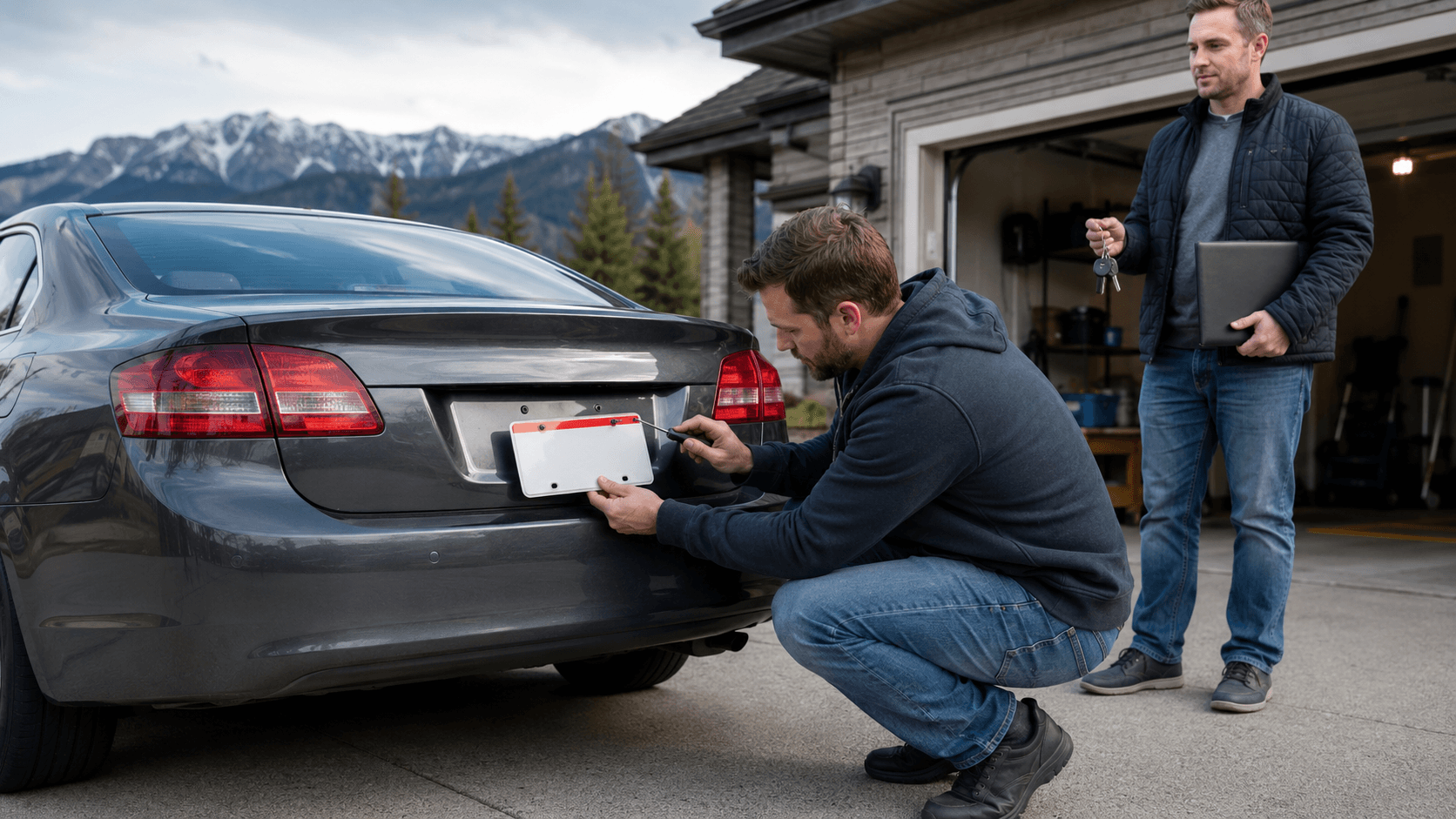
There’s one fact that explains almost everything about this process, and it catches out nearly everyone who has moved to Alberta from somewhere else:
In Alberta, your licence plates belong to you — not to your car.
They are not part of the vehicle. They do not go with it when you sell. They are, functionally, yours to carry from one vehicle to the next for as long as you keep driving in this province. A great many people learn this the hard way, standing in a driveway watching a car they just sold disappear down the street with their plates still bolted to it.
Here’s how the whole thing actually works, and how to avoid the handful of mistakes that create real problems later.
This is general information, not legal advice. Requirements and fees change. An Alberta registry agent can confirm anything specific to your situation.
What “Transferring Plates” Actually Means
The wording confuses people, so it’s worth being precise.
You’re not transferring the plate to the buyer. You’re moving your registration from one vehicle to another, and taking the physical plate with you when you do it. The plate is simply the visible part of a registration that belongs to you.
So when you sell a car and buy another one, the sequence is:
- Take your plate off the car you sold
- Go to a registry agent
- Register your new vehicle under the same plate
The plate number stays the same. The vehicle behind it changes. Your registration follows you, not the metal.
At the Moment of Sale: Remove the Plates First
This is the single most important practical step, and it needs to happen before the vehicle leaves your property — not later that day, not once you’ve found a screwdriver, and not after the tow truck has pulled away.
Once the car is gone, retrieving your plates means chasing down a stranger who has no particular reason to be helpful, or paying to replace them.
Keep a screwdriver where you’ll find it. Take both plates if the vehicle carries two. Do it while the buyer is still standing there.
Why it matters beyond the inconvenience: a plate that stays on a sold vehicle is still associated with your registration. If that car picks up parking tickets, infractions, or gets abandoned somewhere, the paper trail points back at you. Your bill of sale is your defence — but the far easier approach is not creating the problem in the first place.
What the Buyer Needs (And Why They Can’t Drive Away on Your Plates)
Buyers frequently assume they can drive the car home on the seller’s plates and sort things out afterwards. They can’t, and letting them try puts you in an awkward position if something happens en route.
To register a used vehicle in Alberta, a buyer typically needs:
- The signed bill of sale, showing both parties, the date, the VIN, odometer reading and sale price
- Valid Alberta insurance on the vehicle — Alberta requires proof of insurance before registration, so the buyer arranges coverage first
- Identification and proof of Alberta residency
They can then register the vehicle and receive their own plate, or transfer their existing plate onto it.
If the buyer needs to move the vehicle before registering it, that’s what an in-transit permit is for — a short-term permit obtainable from a registry agent that allows an unregistered vehicle to be moved legally.
If the vehicle is being towed away — a scrap or non-running car, for example — none of this applies. It doesn’t need plates, registration or insurance to be loaded onto a deck and removed.
Your Three Options for the Plate
Once it’s off the car, you have three legitimate paths.
Option 1: Transfer the registration to your replacement vehicle
The most common outcome. Take your plate, your bill of sale for the new vehicle, proof of insurance on it and your ID to a registry agent. They’ll move the registration across. Depending on the registration terms and expiry dates involved there may be a fee or an adjustment — the agent will explain it at the counter.
Option 2: Hold onto it
If you’re not replacing the vehicle immediately — you’re between cars, moving, or taking a break from driving — you can simply keep the plate. Be aware that registration has an expiry date, and a plate sitting in your garage doesn’t renew itself. If a significant gap is likely, ask a registry agent what happens to your registration in the meantime and whether anything needs to be done to keep the plate usable.
Option 3: Return it
If you don’t need it, hand it in at any registry agent. Ask at the same time whether any refund applies to the unused portion of your registration — it may, depending on the circumstances, and it isn’t always offered unprompted.
What you should not do is toss them in a drawer and forget about them indefinitely, or leave them in the vehicle out of politeness.
Don’t Cancel Your Insurance Too Early
A sequencing mistake that costs people money.
Cancel your auto insurance after the sale is complete and the vehicle has physically left — not before. Two reasons:
- You may still need coverage right up to the moment it goes, particularly if you’re driving it to meet the buyer.
- Alberta’s insurers are private, which means cancelling mid-term often produces a prorated refund on the unused portion of your premium. Call your broker once the sale closes and ask specifically about a refund. It’s not always volunteered.
If you’re replacing the vehicle, coverage usually moves to the new car rather than being cancelled — talk to your broker before the sale so there’s no gap.
Personalized and Specialty Plates
If you’ve paid for a personalized plate, you almost certainly want to keep it — and you can. Personalized plates can generally be moved to another vehicle the same way a standard plate can.
The critical part is that it comes off the sold car. A personalized plate lost with a vehicle is not easily replaced, and a buyer has no claim to it whatsoever.
Accessible parking placards are a separate matter. A placard is issued to a person, not a vehicle, and it stays with the individual. It should never be left in a car you’re selling.
Situations That Work Differently
Leased vehicles
The leasing company is typically the registered owner. Plate handling at lease end depends on the arrangement, so confirm with the leasing company before you unbolt anything.
Company-registered vehicles
The registration belongs to the business entity, and the person handling it needs authority to act on the company’s behalf.
A deceased owner’s vehicle
Plates cannot be passed to a beneficiary along with the car. They belong to the deceased’s registration and should be returned to a registry agent. Only the estate’s personal representative has authority to deal with the vehicle at all.
Out-of-province plates
If you’re selling a vehicle still registered elsewhere, those plates go back to that province’s issuing authority — not to an Alberta registry.
Selling a scrap or non-running vehicle
Same rule, no exceptions. Plates come off before it’s loaded. The tow doesn’t require them and the buyer has no use for them.
Quick Checklist for Sale Day
- Screwdriver ready before the buyer arrives
- Plates off before the vehicle moves
- Bill of sale signed, with VIN, odometer, price and both parties — keep your copy
- Personal belongings cleared from the vehicle
- Accessible parking placard removed if you have one
- Insurance cancelled or transferred after the sale, with a refund query
- Plate transferred, held, or returned within a reasonable time
The One Thing to Remember
The plate is yours. The car is the thing you’re selling.
Get that distinction right and everything else in this process is straightforward — a screwdriver, a bill of sale, and a short visit to a registry agent.