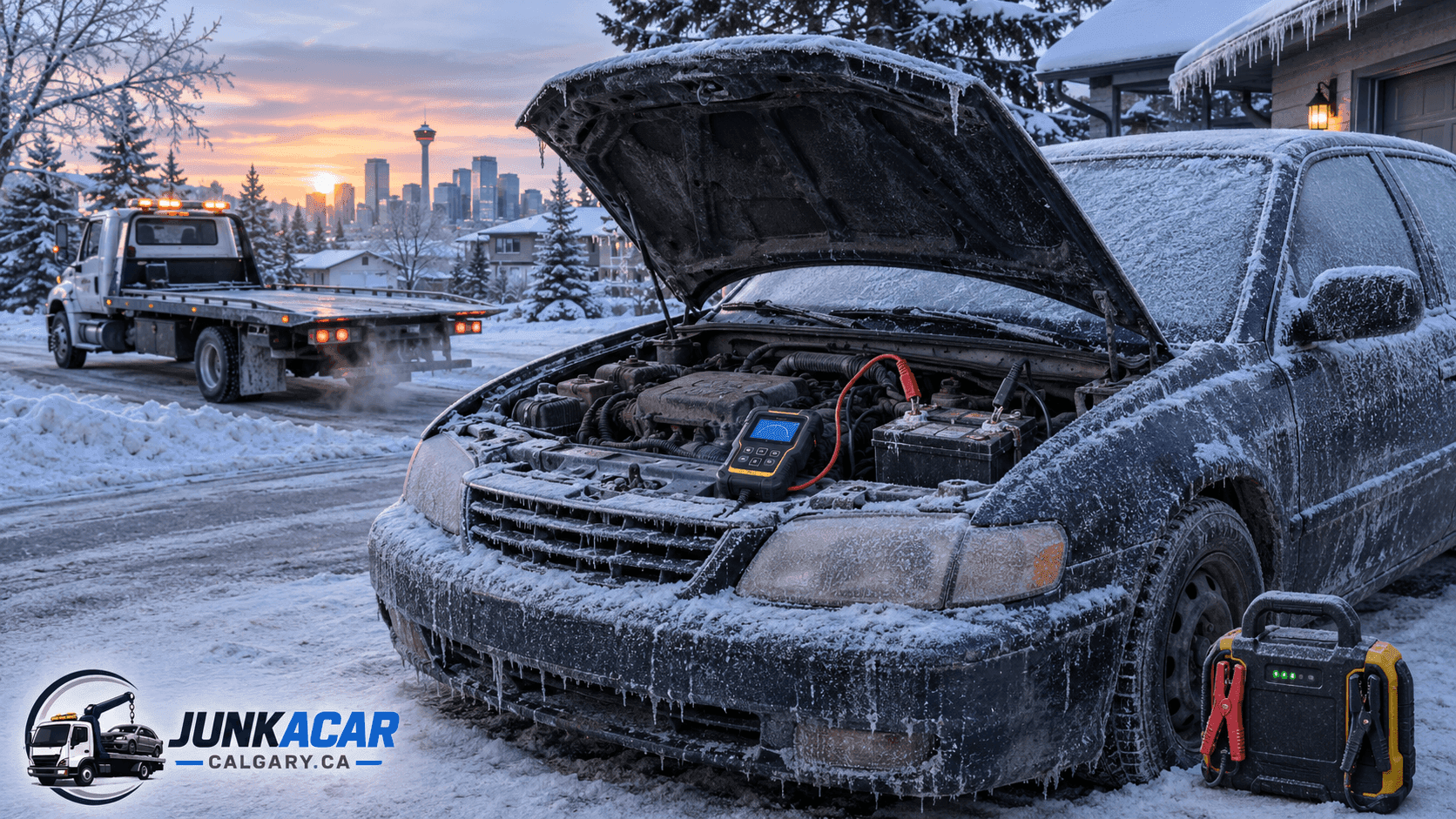
It is minus 28, you are already late, and the engine gives you nothing but a slow, sad crank. Every Calgary winter, thousands of drivers have the same morning. For a newer car, it is usually a cheap fix. For an older one, a no-start in January is often the moment you find out the car has been on borrowed time. This guide helps you decide, step by step, whether your car that won't start in the cold is worth fixing or whether it is smarter to sell it as-is and stop pouring money into it.
Why Cars Fail to Start in a Calgary Cold Snap
Cold weather attacks the battery first. The Alberta Motor Association (AMA) has explained that extreme cold pulls voltage out of a battery, and that once temperatures reach around minus 15, even a newer vehicle may not start. Engine oil also thickens in the cold, so a weak battery has to turn over an engine that is harder to spin.
The scale of the problem is real. During cold snaps, AMA has reported dead-battery calls running at several times the normal volume, and in February 2019 it logged about 17,500 roadside calls in a single 24-hour period. When the whole city is calling for a boost, wait times stretch for hours, sometimes days.
The usual suspects, from cheapest to most expensive
- Weak or old battery: batteries generally last about three to five years, and AMA suggests having one that is about three years old or less heading into winter.
- Block heater not plugged in or not working: a dead cord or heater element is a common winter failure.
- Thick conventional oil: AMA recommends synthetic or semi-synthetic oil because it does not thicken as much in the cold.
- Corroded battery cables or a failing alternator: the battery keeps going flat even after a boost.
- Starter motor failure: you hear a click, but nothing turns.
- Fuel or ignition problems: the engine cranks normally but never fires.
Step 1: Figure Out What Is Actually Wrong
Before you spend a dollar or make a decision, listen to what the car does when you turn the key or press the button.
| What you hear or see | Likely cause | Typical fix level |
|---|---|---|
| Slow, labouring crank | Weak battery or thick oil | Low: battery, boost, oil change |
| Rapid clicking, dash lights flicker | Dead battery or bad cable connection | Low: battery or cable cleaning |
| Single loud click, no crank | Starter motor or solenoid | Medium |
| Normal crank, engine never catches | Fuel delivery, ignition or sensor fault | Medium to high |
| Starts after a boost, dies again next day | Alternator or parasitic drain | Medium |
| Grinding, knocking or warning lights after start | Deeper engine trouble | High |
One practical note: AMA has said it may suspend battery testing and replacement during extreme cold, because parts under the hood become brittle. If your car dies in a deep freeze, you may have to wait for milder weather to get a proper diagnosis.
Step 2: Run the Repair-or-Sell Math
Here is a simple rule of thumb we use when helping owners decide. Add up the repair estimate plus any work you already know is coming in the next 12 months (tires, brakes, a cracked windshield, a looming inspection). Then compare that total to what the car is realistically worth once fixed.
- Repair total under 25% of the car's value: fix it. A battery or block heater on a solid car is money well spent.
- Repair total between 25% and 50%: get a second opinion and think about how long you plan to keep it.
- Repair total over 50%: selling as-is usually comes out ahead, especially on a high-kilometre vehicle.
Do not forget the hidden costs of keeping a car that keeps failing: missed shifts, taxi rides, tow bills, and the risk of being stranded somewhere cold. Safety matters too. AMA advises getting to a warm place rather than waiting inside a broken-down car in extreme cold.
Step 3: Watch for the "One More Winter" Trap
The most expensive mistake is fixing an old car one small repair at a time. A battery in November, a starter in December, an alternator in January. Each bill looks reasonable on its own, but together they can match the car's entire value, and you still own an old car at the end of winter.
Ask yourself three questions:
- Is this the second or third cold-weather failure this season?
- Has a mechanic mentioned rust, leaks or engine wear on top of the current problem?
- Would you buy this exact car today, for its current value, knowing what you know?
If you answered yes to the first two and no to the third, the car is telling you something.
Selling a Car That Won't Start: What to Expect
A car that won't start can still be sold, and you do not need to fix it first. Private buyers tend to avoid non-running cars or make very low offers because they have to arrange a tow and guess at the problem. A junk car buyer prices the vehicle on its make, model, year, parts and metal, and handles the tow.
If you want a sense of value before you call, our guide to what a junk car is worth in Calgary breaks down typical prices by model. It helps you spot a lowball offer.
Quick checklist before pickup
- Find your registration certificate and photo ID
- Clear snow around the car so the tow truck can reach it
- Remove personal items, parking passes and garage remotes
- Take off your licence plate, since Alberta plates stay with the owner
- Have keys ready if you have them (it still helps even if the car won't start)
Car Won't Start in the Cold? Turn It Into Cash in Calgary
If the math says the car is not worth another repair, you do not have to wait for spring or a boost that never comes. Junk A Car Calgary buys cars that won't start, in any weather, with free towing anywhere in the city. Get a quick quote on our sell your car for cash in Calgary page, and we can often pick it up the same day, snowbank and all.
Frequently Asked Questions
At what temperature do cars stop starting in Calgary?
There is no single cut-off, but AMA has said that once temperatures hit around minus 15, any vehicle, new or old, may struggle to start if it is not plugged in. Older batteries, conventional oil and a broken block heater make failure much more likely as temperatures drop further.
Should I replace the battery on an old car before selling it?
Usually not. A new battery rarely adds as much to the sale price as it costs you, especially when selling to a junk car buyer. Buyers price a non-running car based on its parts, metal and model. Save the money unless you plan to keep driving the car.
Can you sell a car that won't start in Calgary?
Yes. Junk car buyers regularly purchase non-running vehicles and tow them away at no charge. You need proof of ownership and photo ID, and you sign a bill of sale. The car does not need to run, pass inspection or have valid registration.
How long does a car battery last in Alberta?
Car batteries typically last around three to five years. Alberta's cold winters are hard on them, which is why AMA recommends going into winter with a battery that is about three years old or newer and getting it tested before the first deep freeze.